On this page
- Where Sulawesi Actually Begins: Choosing Your Entry Point
- The Highlands of Tana Toraja: Villages, Ceremonies, and Cliff Tombs
- Makassar and the South: Urban Pulse, Waterfront, and Day Escapes
- Manado and North Sulawesi: Bunaken, Volcanoes, and Lake Tondano
- Central Sulawesi and Togean Islands: The Slow Route Through the Middle
- Getting Around Sulawesi in 2026: Flights, Roads, and Ferries
- 2026 Budget Reality: What Sulawesi Actually Costs
- Frequently Asked Questions
💰 Click here to see Indonesia Budget Breakdown
💰 Prices updated: September, 2026. Budget figures are estimates — always verify before travel.
Exchange Rate: $1 USD = Rp17,928.47
Daily Budget (per person)
Shoestring: Rp358,569 – Rp896,424 ($20.00 – $50.00)
Mid-range: Rp1,254,993 – Rp2,689,271 ($70.00 – $150.00)
Comfortable: Rp2,689,271 – Rp4,482,118 ($150.00 – $250.00)
Accommodation (per night)
Hostel/guesthouse: Rp71,714 – Rp179,285 ($4.00 – $10.00)
Mid-range hotel: Rp448,212 – Rp896,424 ($25.00 – $50.00)
Food (per meal)
Budget meal: Rp26,893.00 ($1.50)
Mid-range meal: Rp143,428.00 ($8.00)
Upscale meal: Rp537,854.00 ($30.00)
Transport
Single metro/bus trip: Rp3,500.00 ($0.20)
Monthly transport pass: Rp200,000.00 ($11.16)
Where Sulawesi Actually Begins: Choosing Your Entry Point
Most first-timers arrive in Sulawesi with a rough idea of what they want — Torajan funerals, world-class diving, maybe a waterfall or two — but no clear sense of where to land. In 2026, this question matters more than ever. Sulawesi has four practical international or major domestic entry points: Makassar (Sultan Hasanuddin Airport) in the south, Manado (Sam Ratulangi Airport) in the north, Palu in the centre, and Kendari in the southeast. Direct international connections from Kuala Lumpur and Singapore still arrive mainly through Makassar and Manado. Domestic connections from Jakarta, Bali, and Surabaya cover all four.
The honest answer is this: if you have two weeks, fly into Makassar and out of Manado (or reverse it). That open-jaw routing lets you move through the island without backtracking. If you only have 10 days, base yourself in Makassar and go south-to-north as far as Toraja, then return. Trying to do Manado and Toraja in under a week is a recipe for exhaustion — the distances on this island are genuinely deceptive.
The Highlands of Tana Toraja: Villages, Ceremonies, and Cliff Tombs
Eight to nine hours north of Makassar by road — or a short flight to Rantepao via the small Pongtiku Airport — Tana Toraja is the reason many people come to Sulawesi at all. The highlands sit at around 700 to 1,100 metres elevation, which means cool mornings and the smell of woodsmoke drifting through mist at dawn, a sharp and welcome contrast to the coastal heat you left behind.

Torajan culture is built around a deeply layered relationship with death. The Rambu Solo funeral ceremony is the most significant social event in a Torajan person’s life — often held months or years after the actual death, when the family has saved enough money to host hundreds of guests and sacrifice dozens of buffalo. If you happen to be in Toraja between July and September (peak ceremony season), you may be invited to attend one. Show up in dark clothing, bring a small cash gift in an envelope, and follow the lead of your guide. The sound of a hundred voices in chorus and the acrid smell of open flames over sacrificial animals is something that stays with you long after you leave.
Beyond ceremonies, the key sites around Rantepao are:
- Kete Kesu — a traditional village with tau-tau (wooden effigies of the deceased) perched in cliff-side graves. The carved ancestral houses (tongkonan) here are among the best-preserved on the island.
- Lemo and Londa — limestone cliffs honeycombed with burial caves. At Londa, you can walk inside with a lantern and see coffins stacked deep in the rock.
- Batutumonga — a ridge village about 1,200 metres up with sweeping views over rice terraces. Worth an overnight stay if you want quiet mornings completely free of tour groups.
- Pallawa — one of the most photogenic tongkonan clusters, less visited than Kete Kesu and better for wandering slowly.
Spend at least three nights in Toraja. Two nights feels rushed. Four is ideal if ceremonies align with your dates.
Makassar and the South: Urban Pulse, Waterfront, and Day Escapes
Makassar does not get the credit it deserves. Indonesia’s fifth-largest city has a confident, coastal energy — it is not trying to be Bali, and that is exactly what makes it interesting. The Losari Beach waterfront is the city’s social spine: every evening from around 5 p.m., families, teenagers, and street food vendors converge along the promenade. The smell of grilled coto Makassar offal soup wafts from small stalls, and there are always men selling pisang epe (grilled banana with palm sugar) from charcoal carts just off the main walkway.

Key things to do in and around Makassar:
- Fort Rotterdam — a Dutch colonial fortress from the 17th century, now a well-maintained museum complex. Free to enter, worth an hour of your time.
- Paotere Harbour — the traditional Bugis pinisi schooner port. Come early morning (before 8 a.m.) to watch cargo being loaded by hand onto wooden vessels that still sail to Borneo and eastern Indonesia.
- Rammang-Rammang — about 40 kilometres north of the city, this karst landscape of limestone towers rising above rice paddies and mangrove waterways is one of the most underrated places in all of Indonesia. Hire a local canoe to move through the narrower channels.
- Bantimurung Waterfall and Butterfly Park — 50 kilometres east of Makassar, popular with local families on weekends. The waterfall is genuinely powerful in wet season.
One or two nights in Makassar is the right amount before heading north to Toraja, or south toward the Bira Peninsula for beach time and pinisi boat-building villages at Tanaberu.
Manado and North Sulawesi: Bunaken, Volcanoes, and Lake Tondano
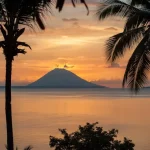
North Sulawesi is a completely different world from the south. The population here is predominantly Christian, the food is louder and more adventurous (think rica-rica chilli, smoked tuna, and dog meat that is openly offered on menus — know your comfort zone before ordering), and the landscape shifts between active volcanoes, highland lakes, and some of the best-preserved coral reefs on earth.
Bunaken Marine National Park sits just 30 minutes by speedboat from Manado harbour. The wall diving here is exceptional — sheer coral cliffs dropping hundreds of metres into blue water, with visibility regularly exceeding 30 metres. In 2026, the marine park entrance fee is IDR 150,000 for foreign visitors (a small increase from 2024 rates to fund reef restoration programmes). Stay on Bunaken island itself for at least one night — the pace drops completely, and night dives off the jetty reveal entirely different creatures than the daytime walls.

North Sulawesi highlights beyond Bunaken:
- Tomohon and the Minahasa Highlands — a cool highland town surrounded by three volcanoes. The Tomohon Traditional Market is genuinely confronting (live and prepared exotic animals are sold openly) but it is an authentic window into Minahasan food culture. The market operates every morning.
- Mount Lokon and Mount Mahawu — two accessible volcanoes near Tomohon. Mahawu has a turquoise crater lake and is a manageable 2–3 hour return hike. Check volcanic activity status with PVMBG (the Indonesian volcanology agency) before you go — both were at Level I (normal) as of early 2026.
- Lake Tondano — a large highland lake ringed by warung serving fresh lake fish. The Sunday morning market at Tondano town is one of the most local, untouristed experiences in the whole north.
- Tangkoko Nature Reserve — about 60 kilometres from Manado, this lowland forest is one of the only places on earth to see the tarsier (one of the world’s smallest primates) and the Sulawesi bear cuscus in the wild. Night walks here are extraordinary.
Central Sulawesi and Togean Islands: The Slow Route Through the Middle
Most itineraries skip central Sulawesi entirely. That is understandable — Palu, the regional capital, was heavily damaged in the 2018 earthquake and tsunami, and infrastructure in the interior remains patchy. But in 2026, the rebuilding is largely complete, and the Togean Islands in the Gulf of Tomini have quietly become one of Indonesia’s best-kept secrets for travellers who want reef without the crowds.
Getting to the Togeans takes commitment. The standard route is a flight to Palu or Gorontalo, then a combination of road travel and ferry to the port of Ampana or Gorontalo, followed by a slow ferry to the islands. The ferry from Ampana takes around 5–8 hours depending on which island you are heading to. Kadidiri and Una Una are the two most visited islands — Kadidiri for budget beach bungalows and snorkelling, Una Una for the active volcano that rises dramatically from the middle of the island.
The Togeans are home to all four major coral environments in a single area: fringing reef, barrier reef, atoll, and patch reef. The diving is not as polished or serviced as Bunaken, but the biodiversity — including pygmy seahorses, Tomini tang, and occasional whale sharks — rewards patience. WiFi is essentially absent. Power comes from generators that run limited hours. That is the point.
Allow at least four nights in the Togeans if you make the effort to get there. Three nights feels like you arrived and immediately had to leave.
Getting Around Sulawesi in 2026: Flights, Roads, and Ferries
Sulawesi’s geography — that distinctive four-armed shape — means surface travel between major regions is long. The Trans-Sulawesi Highway connects Makassar in the south to Manado in the north, but it is an 1,800-kilometre stretch and the full drive takes over 30 hours across multiple days. In 2026, significant sections between Mamuju and Palu have been upgraded as part of the national Trans-Sulawesi road project, cutting travel times on that stretch by around 2–3 hours compared to 2024. Still, this is not a quick drive.
Domestic Flights
The fastest and most practical way to cover long distances. The Makassar–Manado route takes about 1 hour 40 minutes and is served daily by Lion Air, Garuda, and Batik Air. Makassar–Palu is about 1 hour. Manado–Gorontalo is 45 minutes. Book through Traveloka or directly with airlines — in 2026, Traveloka’s price-match feature often beats airline websites for domestic routes.
Long-Distance Buses and Travel Cars
The Makassar–Rantepao (Toraja) route is the most popular overland trip in Sulawesi. Travel cars (shared minivans booked as a full seat) depart from Makassar’s Daya terminal area from around 7 a.m. and 8 p.m. The night bus is the most common choice — depart in the evening, arrive in the morning. Budget around IDR 180,000–250,000 per seat. Private drivers for the full Makassar–Toraja journey cost around IDR 1,500,000–2,000,000 for the car, which makes sense split between three or four people.
Ferries and Boats
PELNI (the national ferry company) still operates long-haul routes connecting Makassar with Bau-Bau, Kendari, and eastern Indonesia. For island hops like reaching the Togeans, local wooden ferries (kapal kayu) and speedboats are the standard. In 2026, most departure schedules for Togean-bound ferries can be checked via the online PELNI portal or via local guesthouses on WhatsApp — always confirm the day before departure.
2026 Budget Reality: What Sulawesi Actually Costs
Sulawesi is consistently cheaper than Bali for comparable experiences, and generally on par with or slightly more expensive than Yogyakarta depending on how far into the island you travel. Here is an honest breakdown for 2026:
Accommodation (per night)
- Budget (backpacker guesthouse, fan room, shared bathroom): IDR 100,000–180,000
- Mid-range (private room, air-con, en suite, breakfast sometimes included): IDR 300,000–600,000
- Comfortable (small boutique hotel or dive resort with pool): IDR 700,000–1,500,000
Food (per meal)
- Warung or local stall: IDR 20,000–40,000
- Mid-range restaurant: IDR 60,000–120,000
- Tourist-facing café or resort dining: IDR 120,000–250,000
Activities
- Bunaken marine park entrance fee: IDR 150,000
- Single dive with equipment rental (Bunaken): IDR 450,000–600,000
- Tangkoko guided night walk (2 hours): IDR 200,000–300,000 plus ranger fee
- Rammang-Rammang canoe hire: IDR 150,000–200,000 per boat
- Toraja village guide (full day): IDR 350,000–500,000
Transport (indicative one-way prices)
- Makassar–Manado domestic flight: IDR 600,000–1,100,000
- Makassar–Rantepao shared travel car: IDR 180,000–250,000
- Ampana–Togean Islands ferry: IDR 80,000–120,000
A realistic daily budget for a mid-range independent traveller in 2026, excluding flights between cities, is IDR 400,000–700,000 per day. Divers should budget an additional IDR 350,000–600,000 per dive day.
Frequently Asked Questions
When is the best time to visit Sulawesi?
May through October is the dry season for most of Sulawesi and the best time to visit. July to September is peak season for Torajan funeral ceremonies. North Sulawesi has a slightly different rain pattern — November to April is wetter there. Diving in Bunaken is best from April through November when visibility is at its highest.
Do I need a visa to visit Sulawesi as a foreign tourist?
Sulawesi follows the same Indonesian visa rules as the rest of the country. In 2026, citizens of 97 countries qualify for the Visa on Arrival (VoA) at major international airports including Makassar and Manado. The fee is IDR 500,000 for a 30-day stay, extendable once for another 30 days at a local immigration office.
Is Sulawesi safe for solo travellers?
Yes, for the vast majority of destinations covered in this guide. Makassar, Toraja, Manado, Bunaken, and Tangkoko all have established tourism infrastructure and are safe to navigate independently. The remote interior regions near Poso have had historical security issues — check current Australian DFAT or UK FCDO travel advisories before travelling to Central Sulawesi beyond the main tourist routes.
How long do I need for a first visit to Sulawesi?
A minimum of 12 to 14 days is needed to do Sulawesi justice without feeling rushed. That allows three nights in Toraja, two in Makassar, two in transit, and five to six nights in North Sulawesi including Bunaken and Tangkoko. Adding the Togean Islands requires at least four extra days on top of that.
Can I use a SIM card and mobile data throughout Sulawesi?
Telkomsel gives the best coverage across Sulawesi, including in rural areas and smaller towns. Buy a Telkomsel SIM at the airport on arrival or at an official outlet in Makassar or Manado. Expect coverage gaps in the Togean Islands, Rammang-Rammang waterways, and the deep Torajan highlands. A 20GB data package costs around IDR 80,000–100,000 in 2026.
Explore more
Beyond Bali: Discover the Best Places to Visit in Sulawesi
Best Places to Visit in Sulawesi: Discovering Indonesia’s Untamed Island
Your Ultimate Tana Toraja Travel Guide: Things to Do & See in Sulawesi