On this page
You land at Ngurah Rai, and within ten minutes you are facing a choice that shapes your whole trip: drive yourself or pay someone to drive you. Rental ads make self-drive look cheap, while forums are full of stories about fines, scratches and stressful junctions. In 2026 the stakes are a little higher. IDP checks are expected to stay strict, and the toll road no longer takes cash. This guide explains how both options work, what they cost in rupiah, and which one suits you.
Self-Drive or Driver: The Short Answer
For most first-time visitors, families and anyone covering long distances, a car with a driver is the better choice. It costs more per day, but you skip the navigation, the parking hunt and the traffic stress. Self-drive suits confident, experienced drivers on a tight budget, or travellers staying mostly in one area and heading to places where a driver might be reluctant to go.
Here is the basic trade-off:
- Self-drive: a lower base price (IDR 220,000 to 700,000 per day), but you pay extra for fuel, parking and tolls. You get maximum freedom to change plans on the spot.
- Car with driver: a higher base price (IDR 650,000 to 1,200,000 per day), usually covering the car, driver and fuel. You get local advice and no stress, and you set the day’s route.
What You Need to Rent and Drive a Car Yourself
The paperwork is not optional. Rental companies and police both look at it.
- International Driving Permit (IDP): mandatory. Your home licence alone is not enough. The IDP must be valid for your entire rental period. Without one, you risk fines, and your insurance can be invalidated after an accident.
- Valid home country driving licence: you show this together with the IDP.
- Passport: for identification.
- Minimum age: most companies require drivers to be at least 21. Some set higher limits for certain vehicles or add a surcharge for drivers under 25.
- Credit card: Visa, Mastercard or American Express, used for the security deposit. Debit cards are usually not accepted for deposits.
Get your IDP before you leave home. It cannot be solved at the rental desk.
How to Rent a Self-Drive Car, Step by Step
1. Book
You can book online through international aggregators such as Kayak or Rentalcars.com, or through local companies such as Bali Car Hire or Bali Cheapest Car Rental. Online booking gives you clearer pricing and often better insurance options. It is also the safer route in peak season. You can also walk into local agencies around Kuta, Seminyak and Ubud, and prices there may be negotiable.

2. Choose your vehicle
Common choices are compact hatchbacks (Toyota Agya, Honda Brio), small MPVs (Toyota Avanza, Daihatsu Xenia) and larger vehicles (Toyota Innova). Automatics are widely available and recommended, because you will be stopping and starting often.
3. Inspect the car
Walk around the car slowly before you sign anything. Check scratches, dents and tyre condition. Take photos or a video, and make sure the fuel level is written on the agreement.
4. Sort out insurance
- Collision Damage Waiver (CDW): reduces your liability for damage to the rental car, often with an excess (deductible).
- Third-Party Liability (TPL): covers damage to other vehicles or property.
- Personal Accident Insurance (PAI): covers medical expenses for people in the car.
Given Bali’s driving conditions, take comprehensive cover, ideally with zero excess.
5. Deposit and payment
A refundable deposit of IDR 2,000,000 to IDR 5,000,000 is held on your credit card. It is usually released 7 to 14 days after you return the car undamaged. The rental fee is normally paid upfront, in cash (IDR) or by card.
What Driving in Bali Feels Like
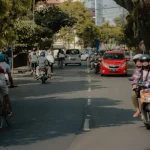
Picture a narrow lane near Canggu at 5 pm. Scooters weave on both sides of your mirrors, a family of three rides past without helmets, and the smell of clove cigarettes and grilled corn drifts through the vents. That is normal here, and you need to stay calm through it.
- Traffic: heavy in southern Bali (Kuta, Seminyak, Canggu) and at peak hours in Ubud.
- Roads: good on main routes, but narrow, winding and sometimes poorly maintained in rural areas.
- Driving habits: motorbikes are everywhere, other drivers can be aggressive, and rules are loosely observed. Drive defensively and leave extra space.
- Navigation: Google Maps and Waze are generally accurate. You need mobile data to use them.
- Parking: limited and difficult in popular areas, which is a big part of why many visitors give up on self-drive in Seminyak and Ubud.

How to Hire a Car with a Driver
This is the most common way tourists see the island. Early in the morning, your driver collects you, the air conditioning is already cold, and you spend the drive watching rice terraces and temple offerings go by instead of watching the road. You do not need an IDP, because you are not driving.
Ways to find a driver
- Through your hotel or villa: usually the most reliable, though sometimes slightly more expensive.
- Reputable local agencies: look for good online reviews.
- Word of mouth: ask friends, fellow travellers or travel forums for trusted contacts.
- Online platforms: some local tour booking sites offer full-day driver services. Gojek and Grab are meant for point-to-point rides, so direct contact or hotel arrangements are still most common.
What is and is not included
The price normally covers the car, the driver and fuel for a full day (8 to 10 hours) or half day (4 to 6 hours). You usually pay extra for:
- Parking: some drivers include minor fees, but at popular attractions you may pay IDR 2,000 to 10,000 per stop.
- Entrance fees: temples, attractions and activities are your responsibility.
- Driver’s lunch: offering to buy it, or giving IDR 50,000 to 75,000, is customary but not mandatory.
- Overnight accommodation: if the driver must sleep outside their home base, you may need to cover it.
- Overtime: usually IDR 50,000 to 100,000 per hour beyond the agreed time.
Agree the hours, the route and the total price before you set off. Payment is usually cash (IDR) at the end of the day, or upfront if booked through an agency.
2026 Budget Reality
These are expected 2026 prices, based on current rates plus normal inflation. Treat them as realistic ranges, not fixed quotes.
Budget
- Small self-drive car (Toyota Agya, Honda Brio): IDR 220,000 to 320,000 per day for a 3 to 7 day rental.
- Fuel: Pertamax (92 RON, recommended) at about IDR 14,500 to 16,500 per litre. Pertalite (88 RON) is cheaper but not recommended for most rental cars and is increasingly restricted.
- Parking: IDR 2,000 to 5,000 per hour or flat rate on streets. Malls and attractions charge IDR 3,000 to 10,000 per hour, with daily maximums.
- Toll (Bali Mandara): IDR 13,000 to 20,000 one way for a passenger car.
Mid-range
- Self-drive MPV (Toyota Avanza, Daihatsu Xenia): IDR 280,000 to 450,000 per day.
- Car with driver, full day, standard car (Avanza, Suzuki Ertiga, up to 4 passengers): IDR 650,000 to 900,000.
- Half day with driver: roughly 60 to 70% of the full-day rate.

Comfortable
- Self-drive SUV or larger MPV (Toyota Innova Reborn): IDR 450,000 to 700,000 per day.
- Car with driver, full day, Innova (up to 6 passengers): IDR 800,000 to 1,200,000.
- Luxury vehicle with driver: IDR 1,500,000 and up.
- Driver tip: IDR 50,000 to 100,000, or 5 to 10% of the daily rate.
Prices for self-drive may be higher for shorter rentals or in peak season. Add fuel, parking and tolls to the self-drive total, and the gap with a driver narrows more than the headline numbers suggest.
Common Mistakes to Avoid
- Arriving without an IDP. Your home licence will not protect you or your insurance.
- Skipping the inspection. Without photos or video, you may argue over old scratches when you return the car.
- Choosing minimum insurance. A small excess can still become a big bill on narrow roads.
- Relying on a debit card. Most companies will not accept it for the deposit.
- Forgetting the e-money card. You will be stuck at the toll gate.
- Not agreeing the driver’s hours. Overtime of IDR 50,000 to 100,000 per hour adds up quickly.
- Underestimating distance. Short distances on the map can take a long time in southern Bali traffic, so build in buffer time.
When a Car Is Not the Answer
Sometimes neither option is right. If you are staying in one area, other transport may cost less and be much easier.
- Gojek and Grab: widely available across southern Bali (Kuta, Seminyak, Canggu, Denpasar) and Ubud, and increasingly elsewhere. They are weaker in very remote regions. A short trip such as Kuta to Seminyak (about 5 km) typically costs IDR 30,000 to 60,000 by car (GoCar, GrabCar) or IDR 15,000 to 30,000 by motorbike. Surge pricing applies at peak times and in bad weather. You can pay with cash, linked cards or e-wallets (GoPay, OVO, LinkAja). “No Gojek/Grab zones” still exist in some areas but are less common than before.
- Motorbike rental: IDR 70,000 to 150,000 per day. An IDP for motorcycles is legally required. Many rental shops do not check, but riding without one can mean fines and invalid insurance. It is also the riskiest option for tourists, and helmets are mandatory and increasingly enforced.
- Bluebird taxis: reputable metered taxis, mostly in southern Bali. They are reliable but can cost more than ride-hailing on short trips. Bluebird has an official app.
- Fast boats: routes run mainly from Padang Bai or Sanur to Lombok (Bangsal) and the Gili Islands (Trawangan, Meno, Air). Expect IDR 300,000 to 600,000 one way. Book online with operators such as Gili Getaway or Eka Jaya, or through local agents.
- PELNI ferries: large, slower ferries link Padang Bai to Lembar in Lombok and to other islands. They mainly serve locals and cargo.

Bali has no KAI intercity trains, MRT, LRT or Trans-Jakarta style BRT. Those belong to Java. Becak and bajaj are also generally not found in Bali, being more common in cities like Jakarta and Yogyakarta.
Frequently Asked Questions
Do I need an International Driving Permit to rent a car in Bali?
Yes. Your home licence alone is not enough. You need a valid IDP, your home licence and your passport, and the IDP must cover the whole rental period. Driving without one can lead to fines, vehicle impoundment and invalid insurance if you have an accident.
How much does a car with a driver cost in Bali in 2026?
For a full day of 8 to 10 hours, expect IDR 650,000 to 900,000 for a standard car and IDR 800,000 to 1,200,000 for an Innova-type vehicle. Luxury cars start at IDR 1,500,000. Half days cost about 60 to 70% of that. Parking, entrance fees and meals are usually extra.
Is it safe for tourists to drive in Bali?
It is manageable for experienced, confident drivers who stay alert. Traffic is heavy in Kuta, Seminyak, Canggu and Ubud, motorbikes are everywhere, and rural roads can be narrow and poorly maintained. First-time visitors and families are usually better off with an experienced local driver.
Can I pay cash on the Bali Mandara Toll Road?
No. Toll gates require a cashless e-money card, such as Mandiri e-Money, BCA Flazz, BNI TapCash or BRI Brizzi. You can buy and top up these cards at Indomaret, Alfamart or banks. The expected 2026 fee for a passenger car is IDR 13,000 to 20,000 one way.
Should I tip my driver in Bali?
Tipping is not obligatory, but it is greatly appreciated for good service. A tip of IDR 50,000 to 100,000, or 5 to 10% of the daily rate, is typical. It is also customary to buy your driver lunch or give a meal allowance of IDR 50,000 to 75,000.
📷 Featured image by Muhammad Irfan on Unsplash.