On this page
- Documents You Need Before You Start the Engine
- Renting a Car or Motorbike in 2026
- The Rules of the Road
- Toll Roads and e-Toll Cards
- Jakarta’s Odd-Even Rule (Ganjil-Genap)
- Fuel Stations and Fuel Types
- Staying Safe: Traffic, Roads, Night Driving, and Accidents
- What Has Changed Since 2024
- 2026 Driving Budget Reality
- When Not to Drive: The Alternatives
- Common Mistakes to Avoid
- Frequently Asked Questions
You land in Indonesia with a rental plan, then discover that a toll road wants a card you do not own, Jakarta restricts your car by plate number, and a camera may mail a fine to your rental company weeks after you leave. Driving here can be rewarding, but in 2026 the rules are more automated and less forgiving than they used to be. This guide covers the paperwork, the road rules, the costs, and the moments when it is smarter to leave the wheel to someone else.
Documents You Need Before You Start the Engine
Foreign visitors must carry a valid International Driving Permit (IDP) alongside their national driver’s licence. The IDP must be recognised by the Indonesian police. Driving without one is illegal and can lead to fines or complications if you have an accident. Many rental shops in tourist areas will hand over keys without asking, but that does not make it legal, and the police will ask at a checkpoint.
Every rented vehicle should come with its STNK (Surat Tanda Nomor Kendaraan), the vehicle registration certificate. This paper proves the vehicle is legally registered. Check that the plate number on the STNK matches the plate on the vehicle, and keep it in the car or in a bag on the bike.
Insurance needs a closer look. Basic third-party liability cover is often included in rental agreements, but comprehensive insurance is highly recommended. Ask exactly what type of cover you are getting and what the coverage limits are before you sign.
Renting a Car or Motorbike in 2026
Car rental agencies operate in major cities and tourist hubs such as Jakarta, Bali, and Yogyakarta. A small car like a Toyota Avanza or Daihatsu Xenia typically costs IDR 350,000 to IDR 600,000 per day for self-drive, excluding fuel and insurance. With a driver, expect IDR 600,000 to IDR 1,000,000 per day, including driver and fuel, for 8 to 10 hours.
Motorbikes and scooters are widely available in tourist areas for IDR 75,000 to IDR 150,000 per day. Before you ride away, test the brakes and lights, and make sure helmets are provided.
- Photograph every scratch and dent before you leave the rental lot.
- Confirm the fuel type the vehicle needs.
- Save the rental company’s phone number so you can call quickly after an accident.
The Rules of the Road
Indonesia drives on the left-hand side of the road. These are the basics:
- Urban speed limits: generally 40 to 50 km/h.
- Rural roads: generally 60 to 80 km/h.
- Toll roads: 60 to 100 km/h, depending on the segment.
- Helmets: mandatory for rider and passenger. Non-compliance brings fines estimated at IDR 250,000 to IDR 500,000.
- Seatbelts: mandatory for all car occupants.
- Mobile phones: using one while driving is illegal and subject to fines.
- Parking: illegal parking can lead to towing or fines, estimated at IDR 100,000 to IDR 500,000.

Speed limits are often poorly enforced or ignored, but electronic traffic law enforcement (ETLE) cameras are becoming more common, so do not assume nobody is watching.
Right of way is where the written rules and daily reality drift apart. Officially, vehicles from the right generally have priority at unmarked intersections. In practice, traffic flow depends on assertiveness, and larger vehicles usually take precedence. Expect unpredictable moves from other drivers, especially motorbikes. Drive defensively and let the bus win.
Toll Roads and e-Toll Cards
Indonesia has an extensive toll road (jalan tol) network, especially on Java with the Trans-Java Toll Road, and on Sumatra. The sleekest part of the experience is also the part that surprises visitors most: all toll payments are cashless. You cannot hand over banknotes at the gate. You need an electronic money card.
The most common cards are:
- e-Toll (Mandiri e-Money)
- Flazz (BCA)
- Brizzi (BRI)
- TapCash (BNI)
You can buy these cards at convenience stores (Indomaret, Alfamart), banks, or toll booths. Top them up at ATMs, minimarkets, or through mobile banking apps. Digital wallet apps like LinkAja or Dana sometimes integrate with toll payment systems, but physical cards are more universally accepted at booths, so carry one.
Fees vary by distance and vehicle class. Driving the full Jakarta-Surabaya Trans-Java toll road could cost approximately IDR 750,000 to IDR 800,000 for a Class I vehicle, which is a private car. Load your card with a comfortable buffer before you leave a city, because a card that runs out at the gate holds up the whole queue behind you.
Jakarta’s Odd-Even Rule (Ganjil-Genap)
On specific major roads in Jakarta, private cars are restricted according to whether the last digit of their licence plate is odd or even, matched against the date. It is typically enforced during peak hours: Monday to Friday, 06:00 to 10:00 and 16:00 to 21:00. It is not enforced on weekends or public holidays.

Rental cars are subject to the rule. Before you drive in Jakarta, look at your plate’s last digit and check the date. The list of roads under ganjil-genap has been periodically updated and expanded since 2024, so check the latest regulations from official sources such as the Jakarta Provincial Government or Polda Metro Jaya, or use a navigation app that shows the restricted zones.
Fuel Stations and Fuel Types
Pertamina, the state-owned fuel company, runs the primary network of stations, and they are widespread. Put the wrong fuel in a rental and you will pay for it, so match the fuel to the vehicle. Estimated 2026 prices per litre:
- Pertalite: subsidised RON 90 gasoline, about IDR 10,000.
- Pertamax: RON 92 gasoline, about IDR 13,500.
- Pertamax Turbo: RON 98 gasoline, about IDR 15,000.
- Dexlite: diesel, about IDR 14,000.
- Pertamina Dex: high-quality diesel, about IDR 15,500.
Payment is typically cash or a digital wallet, such as the MyPertamina app, LinkAja, or Dana. Attendants fill the tank for you, so say the fuel name clearly and check that the pump display resets to zero before they start.
Staying Safe: Traffic, Roads, Night Driving, and Accidents
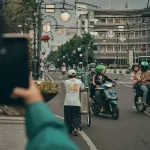
Urban traffic is notoriously dense and often chaotic. Expect long delays, aggressive driving, and swarms of motorbikes weaving between lanes. At a red light in Jakarta at 17:30, the hum of hundreds of engines and the sharp smell of two-stroke exhaust fill the air, and scooters edge past your mirrors on both sides. Motorbikes often ignore lane discipline, traffic lights, and pedestrian crossings, so assume one might appear from any direction.
Outside major cities and the toll network, roads can be poorly maintained, with potholes, uneven surfaces, and limited lighting at night. Be ready for sudden stops and swerving. Avoid long night drives, especially on unlit rural roads, where pedestrians, animals, and unlit vehicles are hard to see.
If you have an accident:
- Stay calm.
- Contact your rental company and the local police immediately.
- Do not admit fault or get into arguments.
- Take photos of the scene and the vehicles involved.
What Has Changed Since 2024
- More ETLE enforcement: cameras are spreading across major cities and highways. That means fewer roadside stops for minor violations, but a higher chance of automatic fines for speeding, red light violations, and helmet non-compliance.
- Cashless everything: payments are almost universal for public transport, toll roads, and ride-hailing. Cash still works for smaller transactions, but digital wallets such as GoPay, OVO, Dana, and LinkAja are preferred. More toll roads are expected to become fully cashless, removing any remaining cash lanes.
- New toll segments: new sections of the Trans-Sumatra and Trans-Java toll roads have opened, improving connectivity for drivers.
- Public transport integration: Jakarta’s MRT, LRT, Trans-Jakarta, and KRL have become better connected, with more seamless transfers and unified payment options in development.

2026 Driving Budget Reality
These figures are estimates for 2026 and can shift with inflation and policy changes.
- Budget: a motorbike at IDR 75,000 to IDR 150,000 per day, plus Pertalite at about IDR 10,000 per litre. Helmet fines, if you skip the helmet, are estimated at IDR 250,000 to IDR 500,000.
- Mid-range: a self-drive Toyota Avanza or Daihatsu Xenia at IDR 350,000 to IDR 600,000 per day, excluding fuel and insurance. Add Pertamax at about IDR 13,500 per litre and tolls on top.
- Comfortable: a car with a driver at IDR 600,000 to IDR 1,000,000 per day, including driver and fuel for 8 to 10 hours. You skip parking stress, ganjil-genap worries, and navigation.
When Not to Drive: The Alternatives
Sometimes the best road rule is to skip the road. Here is what works in 2026.
Ride-hailing: Gojek and Grab
Gojek and Grab are indispensable in cities. Both offer cars (GoCar and GrabCar) and motorbike taxis, or ojek (GoRide and GrabBike). You book through the app, so you need a local SIM or roaming data. Pay with cash or in-app options such as GoPay, OVO, LinkAja, or GrabPay. A 5 km motorbike ride might cost IDR 15,000 to IDR 25,000, and a car for the same distance IDR 30,000 to IDR 50,000, depending on demand and traffic. They are available in Jakarta, Surabaya, Bandung, Medan, Makassar, and Bali, and increasingly in smaller towns.
Jakarta public transport
- MRT: the North-South Line (Lebak Bulus to Bundaran HI) is fully operational. Phase 2 (Bundaran HI to Kota Tua) is under construction and expected to be partially operational by late 2026. Fares run IDR 3,000 to IDR 14,000. Pay with Flazz, e-Money, Brizzi, or TapCash, or with QR tickets in the MRT Jakarta app (jakartamrt.co.id).
- LRT: LRT Jakarta (Velodrome to Pegangsaan Dua) has a flat fare of IDR 5,000 and accepts the Jakarta Tourist Pass. LRT Jabodebek has run fully since 2023, connecting Dukuh Atas to Bekasi and Cibubur, with distance-based fares starting at IDR 5,000 (lrtjakarta.co.id, lrtjabodebek.co.id).
- Trans-Jakarta BRT: dedicated lanes, a flat fare of IDR 3,500 regardless of distance or transfers, and payment by e-money card (transjakarta.co.id).
- KRL Commuterline: connects Jakarta with Bogor, Depok, Tangerang, and Bekasi. Fares are IDR 3,000 for the first 25 km, then IDR 1,000 for every subsequent 10 km, with a maximum around IDR 10,000 to IDR 15,000. Pay with an e-money card or the KMT (Kartu Multi Trip) (commuterline.id).

Trains, flights, and boats
- KAI intercity trains: comfortable travel between Jakarta, Bandung, Yogyakarta, and Surabaya, in classes from Economy to Executive. Jakarta-Yogyakarta Executive could cost IDR 350,000 to IDR 600,000. Book early through the KAI Access app, kai.id, Traveloka, or Tiket.com.
- Whoosh high-speed rail: links Jakarta (Halim) and Bandung (Padalarang/Tegalluar) in about 30 to 45 minutes. Fares are estimated at IDR 200,000 to IDR 300,000 one-way.
- Domestic flights: Garuda Indonesia, Citilink, Lion Air, and Batik Air cover the main routes, along with Pelita Air and Super Air Jet. Jakarta to Denpasar can cost IDR 800,000 to IDR 2,000,000 or more, depending on airline, class, and booking time.
- PELNI ferries: slower than flights but more economical, and some routes carry vehicles. Java to Papua can cost IDR 500,000 to IDR 1,500,000. Book at PELNI offices, through agents, or at pelni.co.id.
- Fast boats: Bali (Padang Bai, Sanur, Serangan) to Lombok and the Gili Islands. Bali to Gili Trawangan typically costs IDR 300,000 to IDR 600,000 one-way, taking about 1.5 to 2.5 hours.
- Becak and bajaj: a becak costs about IDR 10,000 to IDR 30,000 for short rides in smaller towns, and a bajaj IDR 20,000 to IDR 50,000 in Jakarta. Negotiate before you board. Gojek and Grab have largely replaced bajaj.
Common Mistakes to Avoid
- Skipping the IDP. A rental shop handing you keys does not make driving legal.
- Arriving at a toll gate with no card. Cash is not accepted, so buy and load a card first.
- Ignoring ganjil-genap. Rental cars are not exempt, and your plate’s last digit matters.
- Using the wrong fuel. Always check whether your vehicle takes petrol or diesel, and which grade.
- Driving at night on rural roads. Unlit roads hide potholes, animals, and parked vehicles.
- Admitting fault at an accident scene. Call your rental company and the police instead.
- Riding without checking the bike. Test the brakes and lights, and make sure you get helmets.
- Assuming the road rules are followed. Official priority rules exist, but larger vehicles and assertive drivers often take the right of way anyway.

Frequently Asked Questions
Do I need an International Driving Permit to drive in Indonesia?
Yes. Foreign visitors must carry a valid International Driving Permit alongside their national driver’s licence, and the IDP must be recognised by the Indonesian police. Driving without one is illegal and can bring fines or complications after an accident. Carry both documents every time you drive.
Which side of the road do they drive on in Indonesia?
Indonesia drives on the left-hand side of the road, the same as the UK, Japan and Australia. Speed limits are generally 40-50 km/h in urban areas and 60-80 km/h on rural roads, though enforcement varies and ETLE cameras are becoming more common.
How do I pay for toll roads in Indonesia?
All toll payments are cashless, so you need an electronic money card. Common options are e-Toll (Mandiri e-Money), Flazz (BCA), Brizzi (BRI) and TapCash (BNI). Buy one at Indomaret, Alfamart, banks or toll booths, and top up at ATMs, minimarkets or mobile banking apps before you drive.
What is ganjil-genap in Jakarta?
Ganjil-genap is Jakarta’s odd-even plate rule. On specific major roads, private cars can enter only when the last digit of their plate matches the date, odd or even. It typically runs Monday to Friday, 06:00-10:00 and 16:00-21:00, not on weekends or public holidays. Rental cars must follow it too.
Is it safe to rent a motorbike in Indonesia?
Motorbikes are widely available for IDR 75,000 to IDR 150,000 per day, but traffic is dense and unpredictable. A helmet is legally required for rider and passenger, with fines estimated at IDR 250,000-500,000. Check brakes and lights before you ride, and avoid night riding on unlit rural roads.
📷 Featured image by Ammar Andiko on Unsplash.