On this page
- How Safe Are KAI Intercity Trains?
- Comfort by Class: Eksekutif, Bisnis and Ekonomi
- How to Book Step by Step on the KAI Access App
- Other Ways to Buy a Ticket
- Whoosh High-Speed Rail: A Separate Service
- Commuter Trains, MRT and LRT in Jakarta
- 2026 Train Budget Reality
- What Has Changed Since 2024
- Staying Safe at Stations and On Board
- Common Mistakes to Avoid
- Frequently Asked Questions
You have a tight Java itinerary, Flights feel like overkill, and you keep reading mixed advice about Indonesian trains. Will you get a seat? Will it be clean? Will your bag be safe? In 2026 the short answer is yes: train travel on Java is safe, comfortable and often the best way to see the island, as long as you pick the right class and book the right way.
How Safe Are KAI Intercity Trains?
Indonesia’s rail network is run by PT Kereta Api Indonesia (KAI), and its intercity trains on Java have an excellent safety record. Trains are well maintained, tracks are regularly inspected, and operations follow strict safety protocols. Punctuality is generally high, which matters when you are connecting to a flight or a hotel check-in.
For a tourist, the main risks are ordinary ones: a bag left unattended or a phone out in a crowded carriage. Rail accidents are not what you need to plan around. Compared with a long road transfer on a busy highway, most travellers find the train calmer and more predictable.
Comfort by Class: Eksekutif, Bisnis and Ekonomi
Comfort depends mostly on the class you buy. Here is what each one gives you.
- Eksekutif (Executive): The most comfortable option. You get spacious reclining seats, plenty of legroom, air conditioning (AC), power outlets and often individual entertainment screens. Food and drinks are sold onboard.
- Bisnis (Business): Reclining seats and standard AC, but usually less legroom than Eksekutif.
- Ekonomi (Economy): Fixed seats that often do not recline, which gets tiring on long journeys. AC is standard, but carriages can be more crowded.
- Ekonomi Premium / Ekonomi New Generation: KAI’s in-between option, with more comfortable reclining seats that bridge the gap between Ekonomi and Bisnis.
My advice: take Eksekutif for long routes like Jakarta to Yogyakarta, and save Ekonomi for short hops such as Surabaya to Malang. Picture the cool hum of the AC, a paper cup of sweet tea from the food trolley, and green rice fields sliding past the window. That scene is much easier to enjoy when your seat reclines.
How to Book Step by Step on the KAI Access App
The KAI Access app is the main and most convenient way to book. It works on iOS and Android and lets you book up to 90 days in advance. Here is the process for tourists:
- Download and install KAI Access. Register with a local or international phone number and an email address.
- Select “Intercity Train” (Kereta Antar Kota).
- Enter your origin and destination stations, the departure date and the number of passengers.
- Browse the available trains, classes (Eksekutif, Bisnis, Ekonomi) and prices.
- Choose your train and seats.
- Enter passenger details: full name, ID type (choose passport as a tourist) and passport number.
- Go to payment. You can pay with Visa or Mastercard credit and debit cards, bank transfer, or e-wallets such as OVO, GoPay and LinkAja.
- Receive your e-ticket in the app and by email.
- At the station, scan the e-ticket QR code at a self-check-in machine, or show it at the counter to get a physical ticket.

Other Ways to Buy a Ticket
If the app gives you trouble, you have several backups:
- KAI website (kai.id): Similar functions to the app.
- Online travel agents: Tiket.com and Traveloka, plus physical agents.
- Minimarkets: Indomaret and Alfamart offer ticket booking services.
- Station ticket counters: Good for last-minute purchases, but popular routes sell out quickly, so do not rely on them for busy days.
The app and website are usually the cheapest and clearest. They show seat availability and class options in one place, which makes comparing easy.
Whoosh High-Speed Rail: A Separate Service
Whoosh (Kereta Cepat Jakarta Bandung) is not a KAI train. It is managed by PT Kereta Cepat Indonesia China (KCIC) and links Jakarta (Halim) with Bandung (Padalarang/Tegalluar) in approximately 30-45 minutes. Fares are separate from KAI fares and range from IDR 150,000 to IDR 300,000 for standard class, so check the current 2026 price when you book.
Because the Whoosh stations are on the edge of the cities, plan how you will get to your final destination. KAI has increased integration with feeder services for Whoosh, and Gojek or Grab can cover the rest.
Commuter Trains, MRT and LRT in Jakarta
Inside Greater Jakarta you will use different trains with different rules. The KRL Commuter Line covers Jabodetabek (Jakarta, Bogor, Depok, Tangerang, Bekasi). It is very safe for daily commuting and fully air-conditioned, but it gets extremely crowded during peak hours, 06:00-09:00 and 16:00-19:00. With a suitcase, avoid those windows.

How to pay on KRL
- KAI Commuter Multi Trip Card (KMT): Buy it at any KRL station for IDR 30,000, which includes IDR 10,000 balance. It is rechargeable.
- Bank e-money cards: Flazz (BCA), TapCash (BNI), Brizzi (BRI) and e-Money (Mandiri). Buy them at minimarkets or bank branches and top up at stations or minimarkets.
- QR ticketing: Available on the KAI Access app for certain lines, such as the Yogyakarta-Solo KRL.
KRL fares are heavily subsidised: IDR 3,000 for the first 25 km, then IDR 1,000 for every subsequent 10 km. A typical trip within Jakarta costs IDR 3,000-5,000.
MRT and LRT
The Jakarta MRT has excellent safety standards, clean stations and AC carriages that are less crowded than KRL. Pay with the MRT Jakarta app (QR ticketing), a bank e-money card, a Jak Lingko card or a single journey ticket from station vending machines. MRT fares are distance-based, from IDR 3,000 to IDR 14,000 (for example, Lebak Bulus to Bundaran HI). The Jakarta LRT charges a flat IDR 5,000 on lines such as Velodrome to Pegangsaan Dua.
Trans-Jakarta BRT buses complete the picture. They run on dedicated lanes, and the flat fare is IDR 3,500 per journey, including transfers within the system. Tap your Jak Lingko or e-money card on entry and exit.
2026 Train Budget Reality
KAI fares are dynamic, so prices change with class, distance and how early you book. Fares may have risen by 5-10% since 2024 because of inflation. Use these ranges as a guide:
Budget
- Surabaya-Malang, Ekonomi: IDR 50,000 – IDR 80,000
- KRL trip within Jakarta: IDR 3,000 – IDR 5,000
- Trans-Jakarta bus: IDR 3,500 per journey
- Jakarta LRT: IDR 5,000 on flat-fare lines
Mid-range
- Jakarta-Bandung, Eksekutif: IDR 180,000 – IDR 350,000
- Whoosh, standard class: IDR 150,000 – IDR 300,000
- MRT trips: IDR 3,000 – IDR 14,000 depending on distance
Comfortable
- Jakarta-Yogyakarta, Eksekutif: IDR 300,000 – IDR 650,000
- Gojek or Grab to and from stations: about IDR 15,000 – IDR 30,000 for a 5 km ride, or IDR 40,000 – IDR 80,000 for 15 km
For comparison, a Jakarta-Bali economy flight return runs IDR 1,500,000 – IDR 3,500,000. A train fits a Java-only trip better, and it gives you the view for free.
What Has Changed Since 2024
- Newer carriages: KAI keeps upgrading its fleet, especially Ekonomi class, so Ekonomi is more comfortable than it used to be.
- KRL growth: More frequency, new rolling stock and efforts to integrate payment with other public transport through Jak Lingko.
- MRT and LRT extensions: The MRT North-South line is being extended (for example, towards Kota Tua), and the LRT network is expanding in new phases.
- Stable core network: New routes or extensions are possible, but the main intercity network remains stable, so your planning does not need to change much.

Staying Safe at Stations and On Board
A few habits cover almost everything. Keep valuables out of sight, especially in crowded carriages. Carry small IDR notes for street vendors and local transport that do not take cards. A few basic Indonesian phrases, like “permisi” (excuse me) and “terima kasih” (thank you), go a long way at crowded stations.
Getting to the station matters too. Use official apps like Gojek and Grab, and check that the driver and vehicle details match the app before you get in. Both apps offer GPS tracking, driver ratings and emergency buttons. Motorbike taxis are faster in traffic, but with luggage a car is the better choice.
Common Mistakes to Avoid
- Waiting until the last minute: Station counters work for last-minute tickets, but popular routes sell out quickly.
- Choosing Ekonomi for a long trip: Fixed, often non-reclining seats are tiring over many hours.
- Taking KRL at rush hour with a big bag: Peak hours are 06:00-09:00 and 16:00-19:00, and standing is common.
- Mixing up Whoosh and KAI: They are different companies with separate tickets and fares.
- Entering the wrong ID details: Choose passport as the ID type and type the number exactly.
- Forgetting card top-ups: Check your KMT or e-money balance before you tap in.
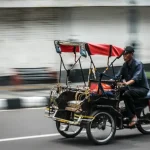
- Relying on becak or bajaj for real distances: They are open to traffic with few safety features. If you try one for fun, agree the price first. Short rides usually cost IDR 15,000 – IDR 50,000.
Frequently Asked Questions
Are KAI trains safe for tourists?
Yes. KAI intercity trains on Java have an excellent safety record and generally run on time. Standard travel precautions still apply, such as keeping valuables out of sight and your bag close, especially in crowded carriages.
Which train class should tourists choose?
Eksekutif is the most comfortable, with reclining seats, ample legroom, AC and power outlets. For long journeys, it is worth the extra cost. Bisnis is a reasonable middle option. Ekonomi works for shorter trips such as Surabaya to Malang, and the newer Ekonomi Premium or New Generation carriages have reclining seats.

Can foreigners book KAI tickets online?
Yes. The KAI Access app and kai.id both accept foreign passports as ID. Enter your passport number exactly as printed. Payment works with Visa or Mastercard credit and debit cards, bank transfers, or e-wallets like OVO, GoPay and LinkAja. You then receive an e-ticket by app and email.
How far ahead can I book a train in Indonesia?
Tickets can be booked up to 90 days in advance through the KAI Access app. Book early for weekends, school holidays and busy routes like Jakarta to Yogyakarta, and you will get more choice of seats and fares.
Is Whoosh the same as a KAI train?
No. Whoosh, the high-speed rail between Jakarta (Halim) and Bandung (Padalarang/Tegalluar), is run by PT Kereta Cepat Indonesia China (KCIC), not KAI. It takes roughly 30-45 minutes. Fares are separate, about IDR 150,000 to IDR 300,000 for standard class, and KAI feeder services connect to it.
📷 Featured image by Fasyah Halim on Unsplash.