On this page
- Do You Actually Need to Drive?
- Legal Requirements Before You Get Behind the Wheel
- How Indonesian Roads Actually Work
- Key Traffic Laws and What They Mean in Practice
- Hiring a Driver vs. Renting Solo
- Navigation, Night Driving, and Road Conditions
- 2026 Budget Reality: What Driving in Indonesia Costs
- Safety on the Road: Accidents, Scams, and Emergency Contacts
- Frequently Asked Questions
In 2026, more travellers than ever are renting cars or scooters in Indonesia — partly because ride-hailing has made them comfortable with informal road culture, and partly because remote destinations like inland Flores or central Kalimantan genuinely require your own wheels. But Indonesia’s roads are not like roads back home. Traffic in Jakarta moves like a river during a flood: fast where it can, stalled where it can’t, and always with motorcycles pushing through every gap. Getting the rules wrong here — or ignoring them — can turn a road trip into a serious problem. This guide gives you exactly what you need to drive legally, safely, and without nasty surprises.
Do You Actually Need to Drive?
This is worth asking before anything else. In most of Java and Bali, self-driving is genuinely optional. Jakarta has the MRT, LRT Jabodebek, KRL commuter trains, and TransJakarta buses covering the city in ways that were impossible five years ago. Gojek and Grab handle short trips across every major Indonesian city at low cost. Intercity trains on Java — including the High-Speed Kereta Cepat Whoosh connecting Jakarta to Bandung in under 45 minutes — have made driving between cities less attractive, not more.
Where driving earns its place is in the outer islands and rural areas: exploring the volcanic highlands of Lombok on a motorbike, navigating from village to village in Sumatra, or reaching a trailhead in East Java that no taxi will bother with. If your destination is urban and well-connected, think carefully before renting. If it’s remote, a vehicle may be your only real option.
Legal Requirements Before You Get Behind the Wheel
Indonesia requires foreign drivers to carry an International Driving Permit (IDP) alongside their valid national driving licence. The IDP is not issued in Indonesia — you must obtain it in your home country before you travel. Without it, you are technically driving illegally, which creates complications with insurance claims and police stops.
For stays exceeding three months, an IDP is no longer sufficient. You must obtain an Indonesian driving licence: SIM A for cars and SIM C for motorcycles. These are issued by POLRI (the Indonesian National Police) at local traffic police offices (Satlantas). The process involves written and practical tests, and for most visitors staying under 90 days, it is not required.
When renting a vehicle, always verify that your rental includes comprehensive insurance. Basic liability-only coverage leaves you exposed to significant costs if another vehicle is damaged or a third party is injured. Ask the rental company specifically what the excess (deductible) is, and whether coverage extends to toll roads and inter-province driving.
How Indonesian Roads Actually Work
Indonesia drives on the left side of the road, the same as Australia, the UK, and Japan. If you come from a right-hand traffic country, the adjustment takes a day or two — intersections and roundabouts are where mistakes happen, so slow down at every one until the instinct becomes automatic.
Lane discipline in Indonesia operates differently from what most Western drivers expect. Lanes are treated as rough suggestions. On a two-lane urban road, you will regularly see three or four lanes of traffic forming organically — cars, motorcycles, and bajaj all sharing the same tarmac with surprising fluency. The key rule is to watch for motorcycles constantly. They filter through traffic at speed, appear in your blind spot without warning, and outnumber cars by a wide margin on most Indonesian roads.
Honking is normal and non-aggressive. A quick beep typically means “I’m here” rather than “you’ve done something wrong.” Larger vehicles — buses, trucks — generally have informal right of way through sheer mass. Do not try to win a gap contest against a loaded Hino bus on a provincial road.
Toll roads are a different experience entirely. Indonesia’s Trans-Java Toll Road now connects Anyer (West Java) to Banyuwangi (East Java) — a route that has transformed overland travel on the island. Toll roads are well-maintained, signposted in Indonesian and English, and use electronic toll payment via e-money cards (Mandiri e-Money, BCA Flazz, BRI Brizzi, BNI TapCash). Cash payments have been phased out at nearly all toll gates. Make sure your rental car has a compatible e-money card with sufficient balance before you start a long toll road journey.
Key Traffic Laws and What They Mean in Practice
The legal framework is clear. Enforcement is variable. Here is what actually matters on the ground:
- Speed limits: 50 km/h in urban areas, 80–100 km/h on highways and toll roads. Posted signs override the defaults. Speed cameras are becoming more common on toll roads.
- Seatbelts: Mandatory for all occupants in a car. Fines are issued, and police do check during roadblocks.
- Helmets: Mandatory for both driver and passenger on motorcycles. Standards-approved helmets only — the thin plastic shells sold at some warungs do not qualify legally or practically.
- Mobile phones: Illegal to use while driving. This includes holding the phone at a red light.
- Drink driving: Zero tolerance. Indonesia does not have a permissible blood alcohol limit that functions as a green light — any detectable alcohol can result in arrest.
Police roadblocks (razia) occur periodically, especially around public holidays. Have your IDP, passport, and rental documents accessible but stored safely. Stay calm, be polite, and do not offer money unprompted — doing so can make a simple documentation check into something more complicated.
Hiring a Driver vs. Renting Solo
For most first-time visitors to Indonesia, hiring a local driver with a car is genuinely better value than renting solo — and not just for safety reasons. A good driver doubles as a local guide, knows which road is flooded after overnight rain, and handles the psychological load of navigating dense urban traffic so you do not arrive at every destination already exhausted.
Driver hire is typically arranged through your accommodation, a local travel agent, or increasingly through apps. Day rates vary by region: in Bali, expect to pay IDR 500,000–800,000 for an 8–10 hour day including the car. In Yogyakarta or Lombok, rates are similar. Long-distance charters (for example, Yogyakarta to Bromo) are negotiated separately and can reach IDR 1,200,000–2,000,000 for multi-day arrangements.
Solo rental makes sense if you are experienced driving in Southeast Asia, you want the freedom of completely unstructured movement, or you are in a low-traffic area like rural Lombok or northern Sumatra where road pressure is manageable. In those contexts, a self-driven car or motorbike gives you a level of flexibility that no hired service can match.
Navigation, Night Driving, and Road Conditions
Google Maps and Waze both work well across Java and Bali in 2026, with reasonably accurate real-time traffic data. In more remote regions — parts of Kalimantan, interior Sulawesi, eastern Indonesian islands — satellite coverage is good but map data can lag behind reality. Roads that appear on Google Maps as paved may be gravel or may no longer exist after erosion. Download offline maps before leaving mobile coverage areas.
Night driving outside major cities carries real risks that no navigation app addresses. Rural Indonesian roads frequently have no street lighting, no road markings, and unexpected hazards: livestock on the road, broken-down vehicles parked without warning lights, deep potholes invisible in headlights. The sensory experience of driving after dark in rural Java — the thick smell of rice paddies, the glow of a roadside warung’s single bulb, the sudden appearance of a cow in your headlights — is vivid for all the wrong reasons. Avoid it where possible.
The Trans-Java Toll Road has genuinely changed overland travel. Where the Jakarta–Surabaya drive once took 12–15 hours on provincial roads, the toll route cuts that significantly with consistent road quality. Rest areas (rest area) along the toll road have grown into well-developed stops with food courts, fuel stations, and clean bathrooms — a marked upgrade from just three years ago.
2026 Budget Reality: What Driving in Indonesia Costs
Here is a realistic breakdown of driving-related costs for 2026:
Vehicle Rental (per day, self-drive)
- Budget: Small manual car (e.g., Toyota Agya or Daihatsu Ayla) from local operators — IDR 200,000–350,000/day, excluding fuel and tolls.
- Mid-range: Automatic MPV (e.g., Toyota Avanza, Daihatsu Xenia) from established operators — IDR 350,000–550,000/day.
- Comfortable: SUV or larger MPV (e.g., Toyota Fortuner, Mitsubishi Pajero) — IDR 600,000–1,000,000/day.
Motorbike Rental (per day)
- Budget: Automatic scooter (Honda Beat, Yamaha Mio) — IDR 50,000–80,000/day in most areas. Bali prices trend slightly higher at IDR 70,000–100,000/day.
Fuel
- Pertamax (RON 92, widely recommended for rental cars): approximately IDR 13,000–14,500 per litre in 2026, subject to government pricing adjustments.
- Pertalite (RON 90, subsidised): IDR 10,000 per litre, though availability and eligibility for non-subsidised vehicles can vary.
Toll Costs (Trans-Java examples, one-way)
- Jakarta to Semarang: approximately IDR 200,000–270,000.
- Jakarta to Surabaya (full toll route): approximately IDR 450,000–500,000.
Driver Hire
- Day rate (car + driver, 8–10 hours): IDR 500,000–800,000 in most regions.
- Multi-day charter: negotiated, typically IDR 600,000–900,000/day all-in.
Safety on the Road: Accidents, Scams, and Emergency Contacts
If you are involved in a road accident, Indonesian law and practical wisdom point in the same direction: do not admit fault, do not offer direct cash payments at the scene, and contact the police immediately by dialling 110. Also call your rental company and insurance provider as soon as possible. In a minor fender-bender, the instinct to settle quickly with cash can seem pragmatic, but it removes your insurance protection entirely and can create liability claims later.
Roadside scams targeting foreign drivers are not rampant, but they exist. The most common involve someone waving you down claiming you have a flat tyre or a problem with your vehicle. Pull only into well-lit, populated areas if you do stop — or continue to the next petrol station. Keep doors locked and windows partially up in slow-moving city traffic.
Roadside mechanical assistance is reliable in urban areas — most rental companies have a contact number — but genuinely scarce on remote routes. Before a long rural drive, check tyre condition, fuel level, and the spare tyre. The smell of burning rubber or an unfamiliar vibration through the steering wheel on a mountain road in Sumatra, with the next town 40 kilometres away, is not a situation you want to problem-solve without preparation.
Emergency contacts to keep accessible:
- Police emergency: 110
- Ambulance / medical emergency: 119
- Search and rescue (BASARNAS): 115
- Your rental company’s emergency number (get this before departing)
Frequently Asked Questions
Can I drive in Indonesia with my home country driving licence?
Not on its own. You need your valid national driving licence plus an International Driving Permit (IDP) obtained in your home country before travel. The IDP must match the vehicle class you are driving — Class B for cars, Class A for motorcycles in most IDP frameworks. For stays over three months, a local Indonesian SIM is required.
Is it safe to rent a motorbike in Bali?
It is possible, and many travellers do it, but the risk is real. Bali’s roads combine tourist inexperience, aggressive traffic, and poor road surfaces in some areas. Ensure you hold a valid motorcycle IDP category, wear a proper helmet, and have travel insurance that explicitly covers motorcycle accidents — many standard policies exclude them without a valid licence.
Do Indonesian toll roads accept cash?
No. Virtually all toll roads in Indonesia, including the Trans-Java Toll Road, operate on fully cashless electronic payment. You need an e-money card — Mandiri e-Money, BCA Flazz, BRI Brizzi, or BNI TapCash — loaded with sufficient balance. Rental cars sometimes come with one included; confirm this before departure and top up at petrol stations or minimarkets (Indomaret, Alfamart).
What happens if I’m stopped by police while driving?
Stay calm and polite. Present your IDP, national licence, passport, and rental documents. Police roadblocks are routine, especially around public holidays. Do not offer money unprompted. If issued a ticket, you have the right to pay through official court channels rather than on the spot. Having your documents in order makes most stops straightforward.
Is driving in Bali different from driving in Java?
Yes, noticeably. Bali’s roads are narrower, with many single-lane temple-lined streets and complex one-way systems in Ubud and Seminyak. Traffic density in south Bali rivals Jakarta during peak times. Java’s intercity routes are more straightforward on the toll road network, though provincial roads can be challenging. Both require high motorcycle awareness at all times.
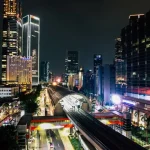
📷 Featured image by Akmal Ayyash on Unsplash.